Asphalt Driveway Replacement in Erie, PA
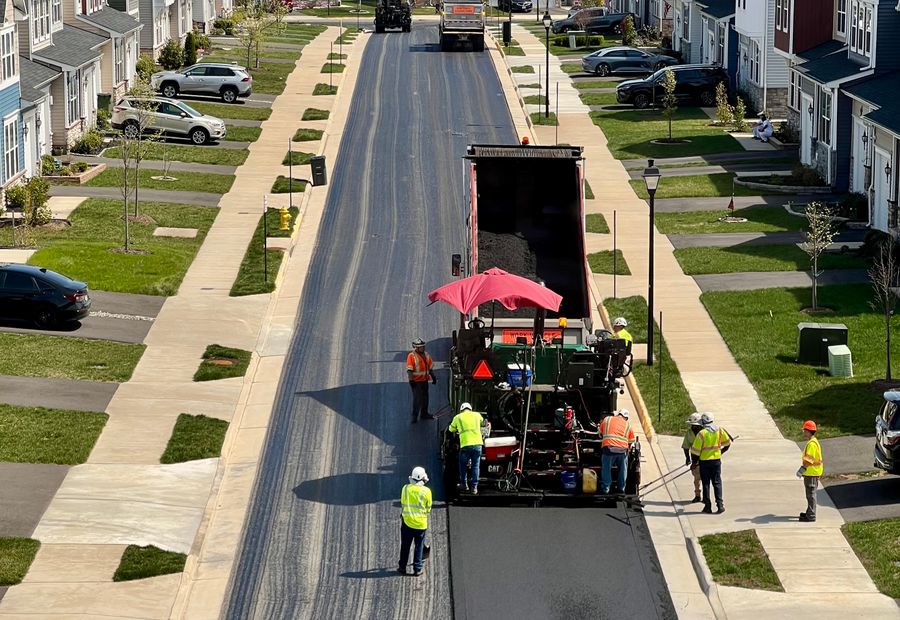
Erie Driveway Paving is an asphalt contractor doing driveway replacement, resurfacing and overlays, patching and repair, new driveway paving, sealcoating, parking lot work, gravel to asphalt conversion, and driveway extensions. We serve houses, rentals, and small commercial property across Erie, Millcreek, Harborcreek, Fairview, Edinboro, and Erie County, Pennsylvania.
A replacement starts with the old surface leaving the property as reclaimed asphalt pavement. Then we rebuild what sits underneath. Roughly six to eight inches of compacted 2A modified stone goes down in lifts on a compacted subgrade, and a steel drum roller works each lift before the next arrives. Hot mix asphalt follows in two courses. A binder course of coarse mix, about two inches compacted, carries the load. A finer surface course on top sheds water and takes the wear. Set that against two inches of hot mix rolled over a driveway that is already cracked through.
Alligator Cracking Is the Base Talking
A web of connected cracks that looks like reptile hide is not surface wear. The ground under the asphalt moves every time a car rolls over it, and the asphalt breaks because it has nothing solid to sit on. That pattern is what separates a replacement from a resurfacing.
New Asphalt Over a Failed Base
Sealer, crack filler, and a fresh overlay all sit above the problem. Put a new layer over a cracked drive and the old cracks work their way up through it in the same lines, usually inside a few years. That is reflective cracking. Checking the base first means cutting a test hole and looking at the stone and the dirt below it.
Compacted Inches, Not Laid Inches
Hot mix loses about a quarter of its depth under the roller. A quote promising three inches of asphalt without the word compacted describes what came off the truck. Ours states compacted base depth and compacted asphalt depth, with the square footage beside them.
Water, Edges, and Height
Every drive gets a real fall so rain runs off instead of standing. Water that sits finds the seams, soaks the base, then freezes and lifts. Edges get the stone run past the asphalt, a rolled taper, and soil brought up level, because a plow blade takes an edge with a drop-off behind it. A replacement also resets the grade. An overlay raises the drive about two inches, which can crowd a garage door and leave a lip at the street.
Matching the Fix to the Failure
| What you see | What it needs |
|---|---|
| Sound surface, gray color, hairline cracks | Crack fill, then sealcoat |
| A few potholes, rest of the drive solid | Full-depth patch of that area |
| Worn and cracked, base solid, drains well | Overlay or resurface |
| Alligatored, rutted, ponding, sinking | Full-depth replacement |
Driveways price by the square foot. Size, asphalt thickness, base depth, tear-out, grading, drainage work, and access for a triaxle and a paver all move the number. Hot mix runs roughly May through October here, because the plants close for winter and cold ground will not let a mat reach density. We measure and quote in any month. Call (814) 555-0131.
How do I know my driveway needs replacing instead of patching?
Look at how much of the surface is cracked and how the water sits. A few potholes in an otherwise solid drive get cut out and patched. A web of connected cracks spread across a large share of the surface is different. So are ruts under the tire tracks, water standing after a rain, crumbled edges, and sections that have dropped. Those all say the ground under the asphalt is moving, and nothing laid on top of moving ground stays flat.
What comes out and where does it go?
The old surface gets torn out or milled off and loaded into trucks. It leaves as reclaimed asphalt pavement, gets crushed at a plant, and goes back into new mix. Failed base stone comes out with it where the subgrade is soft. That haul-off is real work with real trucking behind it, and it is the main reason a replacement prices higher than paving bare ground.
How many days does a replacement take?
Most residential drives run one to three working days. Tear-out and grading take the first day. Base stone goes in and gets compacted next. Paving is often a single day, because hot mix has to be laid and rolled while it is hot. Rain moves a paving day. Cold ground moves it further, and we tell you that before you are on the calendar rather than after.
When can I drive on it?
Cars can usually go on it the next day. Keep heavy trucks, dumpsters, and trailer jacks off it for the first month while the mix hardens. Park in different spots for the first few weeks rather than the same square of asphalt every night. Avoid turning the wheel of a parked car, because that scuffs a new surface course. Nothing about this is fussy. It is just the first summer.